
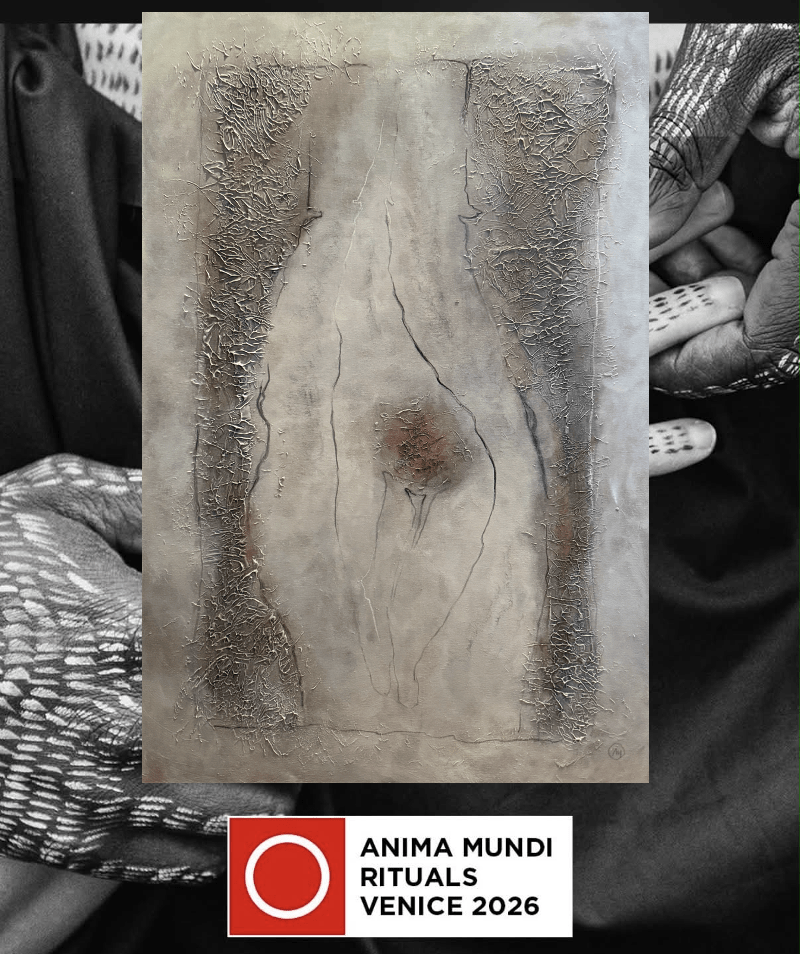
On May 20, 2026, in Venice, Polish artist Malina Wieczorek will present her latest works from the Madonna and Terra Ignota series as part of the group exhibition RITUALS (Anima Mundi). Her introspective, austere, and deeply spiritual paintings will form the heart of the exhibition at the Palazzo Albrizzi-Capello, creating a unique artistic dialogue with the Haiti Pavilion and Enock Placide’s installation Yelena’s Garden.
Both projects—though completely different in form—come together in one space to speak of ritual as a universal language of humanity: a tool for survival, the transformation of identity, and contact with the invisible.
Malina Wieczorek: The Ritual of Painting as an Act of the Sacred
For Malina Wieczorek, the creative process itself is a ritual. For years, the artist has been deconstructing the female body, stripping it of its face and individual features to transform it into a universal archetype. Her Madonnas are figures traumatized, deconstructed, and reclaimed. They are sensual, cosmological, and transcendental. Often monochromatic or maintained in a limited palette, with a clear center in the lower abdomen—the “zero” point from which the axes of life radiate. Bodies swirl, hatch, and become a gateway to infinity. Malina paints “from blood, from earth, from space, from pain, and from healing.”
As she herself emphasizes, “I paint to reclaim the sacredness that has been stripped from women.” In works from the Madonna and Terra Ignota series, the body ceases to be an object of gaze and becomes a field of freedom and metaphysical contemplation. Deformations and simplifications are not accidental—they are a conscious strategy, allowing the viewer to find themselves in the image. The absence of a face makes each figure a mirror for the universal experiences of femininity: motherhood, desire, strength, vulnerability, and transcendence.
Her art combines minimalism of form with immense emotional and philosophical depth. It is a painting ritual in which form “hatches” on the canvas, much like a human being hatches through a spiritual process.
Contrast and Synergy with the Haiti Pavilion
In adjacent rooms, Enock Placide’s installation “Yelena’s Garden” presents ritual from a completely different perspective—through the prism of Haitian history, voodoo beliefs, ancestors, and the lush Caribbean nature. The heated, colorful, collective, and political nature of the Haitian works creates a powerful yet exceptionally fruitful tension with the cool, introspective, and silvery aesthetic of Malina Wieczorek’s Madonnas.
Palazzo Albrizzi-Capello and the Organizers
The RITUALS exhibition is produced by the renowned ITSLIQUID Group in collaboration with ACIT Venice – Italian-German Cultural Association, which hosts and manages Palazzo Albrizzi-Capello. The palace’s Baroque interiors provide an ideal, historically charged backdrop for this encounter. The entire project aligns with the concept of Anima Mundi – Soul of the World.
A Living Poland-Haiti Bond
The selection of Malina Wieczorek for this project, alongside the Haiti Pavilion, also has a historical dimension. The curators refer to the rich Polish-Haiti artistic relationship initiated, among other things, by the Haiti Pavilion. The Halka/Haiti project in 2015 and the accompanying Invisible Pavilion at the Zachęta National Gallery of Art – a symbolic initiative promoting Haitian art and culture in Poland.
For the viewer – a spiritual crossover
Visitors to the palace on May 20th will experience a true spiritual crossover:
Haiti – a passionate, collective ritual, rooted in history and nature,
Malina Wieczorek – a personal, quiet, introspective ritual, leading deep into the self and towards universal archetypes.
Malina Wieczorek’s participation in RITUALS at the 61st Venice Biennale is an important confirmation of the international power of her artistic language.
www.malinawieczorek.com
www.facebook.com/malina.wieczorek/
www.instagram.com/malinawieczorekart/
Contact: +48 501099606